Why September Is Wisconsin's Most Underrated Fishing Month
September may be one of the most overlooked months to hit the water. It makes sense, we've just come off a frantic marathon of summer activities, kids are headed back to school, football season starts back up, and there's a giant exhale that comes with the slowdown of fall's arrival. What's not slowing down, however, is the fishing. The days get shorter and the nights get cooler, waking the predators up to the fall feast. Come mid-September, those fish are starting to resemble Homer Simpson fresh off a month-long fast, just in time for Thanksgiving. Their stomachs are bulging and they are not self-conscious about it as they continue their gluttonous hunt. As an angler, it's simply great — the gentle, methodical, and sometimes skeptical eats of August are gone, and when they suck down your fly, you can be sure a pair of pliers will be needed once they reach the net.
There's a noticeable change in our guide's eyes. New life is breathed into them after a long summer of getting baked in the sun. Getting to show up on a cool morning with a hoodie on brings a sense of rejuvenation that might take a long weekend at a bougie spa to accomplish for most folks — but we don't have time for that, there's fish to catch. We start digging out the waders and figuring out where we put those extra layers as we prep for a diverse guide schedule mixing Wisconsin River smallmouth, toothy critters, and Driftless trout.
The dog days of summer are vanishing in our rearview mirror as we say goodbye to the crowds and watch the vegetation start to die back in Wisconsin's Driftless Region. The trout begin to find comfort in cooler temps again, seeking out any terrestrial that disrupts the surface. All those toothy critter spots we've been eyeing up all summer are now ripe for the picking, and the smallmouth start forming their wolf packs for the fall migration, wolfing down baitfish like they're being paid in shad-stuffed crawfish tails to do so. The options become dizzying, and we cannot encourage you enough to grab a date with us. Let's dig a little deeper into what's actually happening out there.
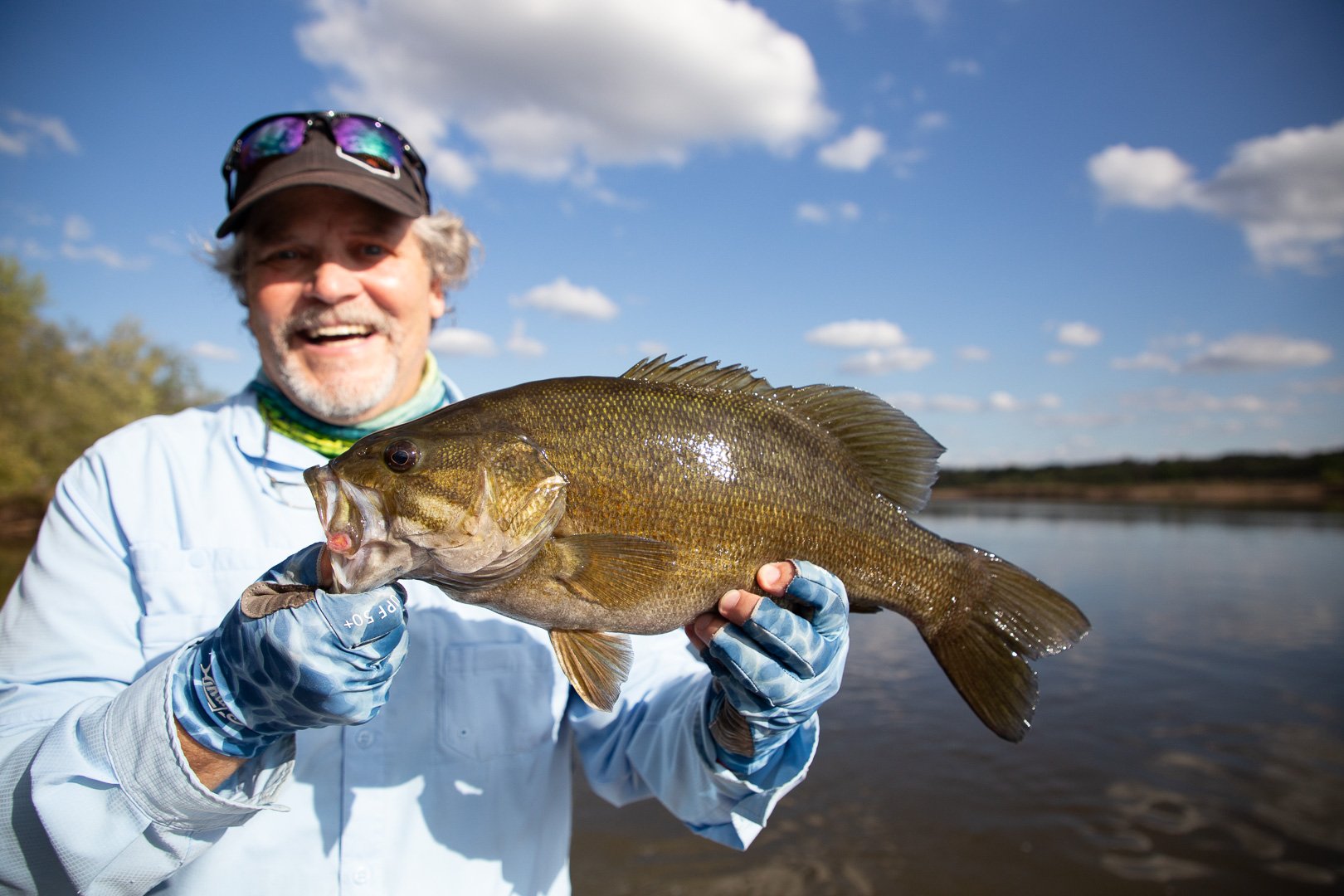
A typical September smallmouth.
The Smallmouth
During the summer months, smallmouth disperse throughout the river system, finding their favorite shady little hidey-hole to advantageously feed during the hot months of the Wisconsin summer. Come August, most fish are highly dispersed throughout the Wisconsin River system. There's a plethora of food options in late summer — baitfish of many kinds, frogs, bugs, snakes, rodents, you name it, it's a smorgasbord. The bite can get finicky as fish key into different food sources from day to day; we've found it to be one of the more technical stretches of the year. Enter September.
September is the transition month between summer and fall in Wisconsin. Southern Wisconsin loses roughly 80 minutes of daylight over the month, and northern Wisconsin loses close to 100 (remember, the water in the Wisconsin River starts at the northern border). The first two weeks look a lot like summer, with smallmouth aggressively feeding on the shallower flats, chasing schools of shad and shiners. Rock structure comes back into play more than it did in August. The real sweet spot tends to land around the second and third week of the month, when water temps generally start showing signs of the fall drop into the 60s. The autumnal equinox falls around the 22nd, and once day and night hours even out, the daylight loss — and the feeding — ramps up.
Why does this matter? Sunlight is the key factor behind changing water temps. It's why you'll see hatches on the spring creeks as early as February — the sun's ability to warm the water swings things dramatically. As we move deeper into autumn, the sun has less and less time to warm the water each day, and that's a triggering event. I'd always heard that smallmouth fishing was "done" after September 15th. That's not true, but it's worth understanding where the idea came from. In many of the smaller northern rivers — often tributaries to larger systems — smallmouth begin their migration to wintering grounds around mid-September. Those smaller rivers often don't have the deep holes fish need to survive winter, so the fish school up and vacate, headed for a flowage, dam, or larger river section, leaving stretches of water temporarily empty.
When that migration happens, you know it. Smallmouth show up schooled up and on a warpath toward whatever spot suits them for weathering the winter — usually deeper pools with good structure. Time it right, stay in tune with the fish, and you can follow the migration into water where catching just one fish would be the rare event. Our fly tactics shift toward streamer patterns, sometimes on intermediate or moderate sinking lines, to better offer up the equivalent of a Culver's butterburger: the minnow. Streamers become the name of the game, and while the bite gets a bit more condition-dependent, it's one that will surprise you if you haven't experienced it before. The Wisconsin River is a great place to chase these fall migrations, and if you like finding yourself hooked into a big ol' toothy critter, you'll be happy to know walleye and pike are common bycatch on a September float.
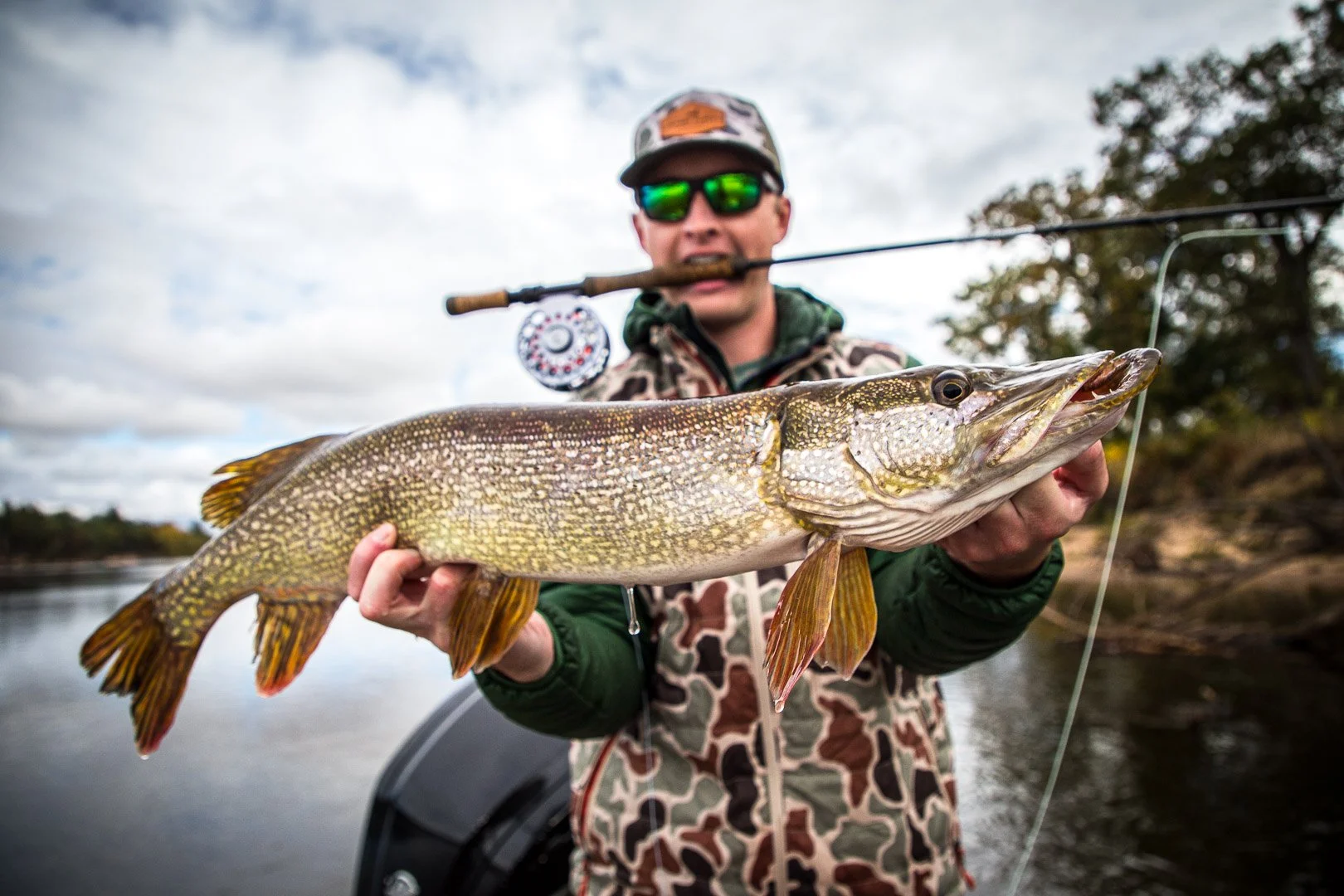
A healthy pike caught on a September morning.
Toothy Critters
As the sun takes its time warming the morning water, pike and musky now hunt comfortably in the cool autumn temps, making this one of the best times of year to sink a hook into a committed pike or musky. The question we get most is: when's the best time to get a toothy critter? September opens that window, and it's not uncommon to get multiple shots at 30-plus-inch pike. The musky, of course, are the serial killers of the river, and they show up whenever they damn well please. We've had our eyes on a number of good skis this year, waiting for the right time to get after them — that time has arrived.
Our toothy critter tactics align with your skill level, and push it a little too. Through September we're often fishing smaller flies on 8- to 10-weight rods most of the day, and may switch you over to a 10- or 11-weight with much larger flies in specific spots. Our theory is simple: we want you casting all day, so we pair you with a setup that lets you do that while still fishing ethically for the target species. If you want a taste of toothy critter fishing, this is a great time to do it — we'll often switch back to smallmouth mid-day as temps warm, so you get a real feel for both.
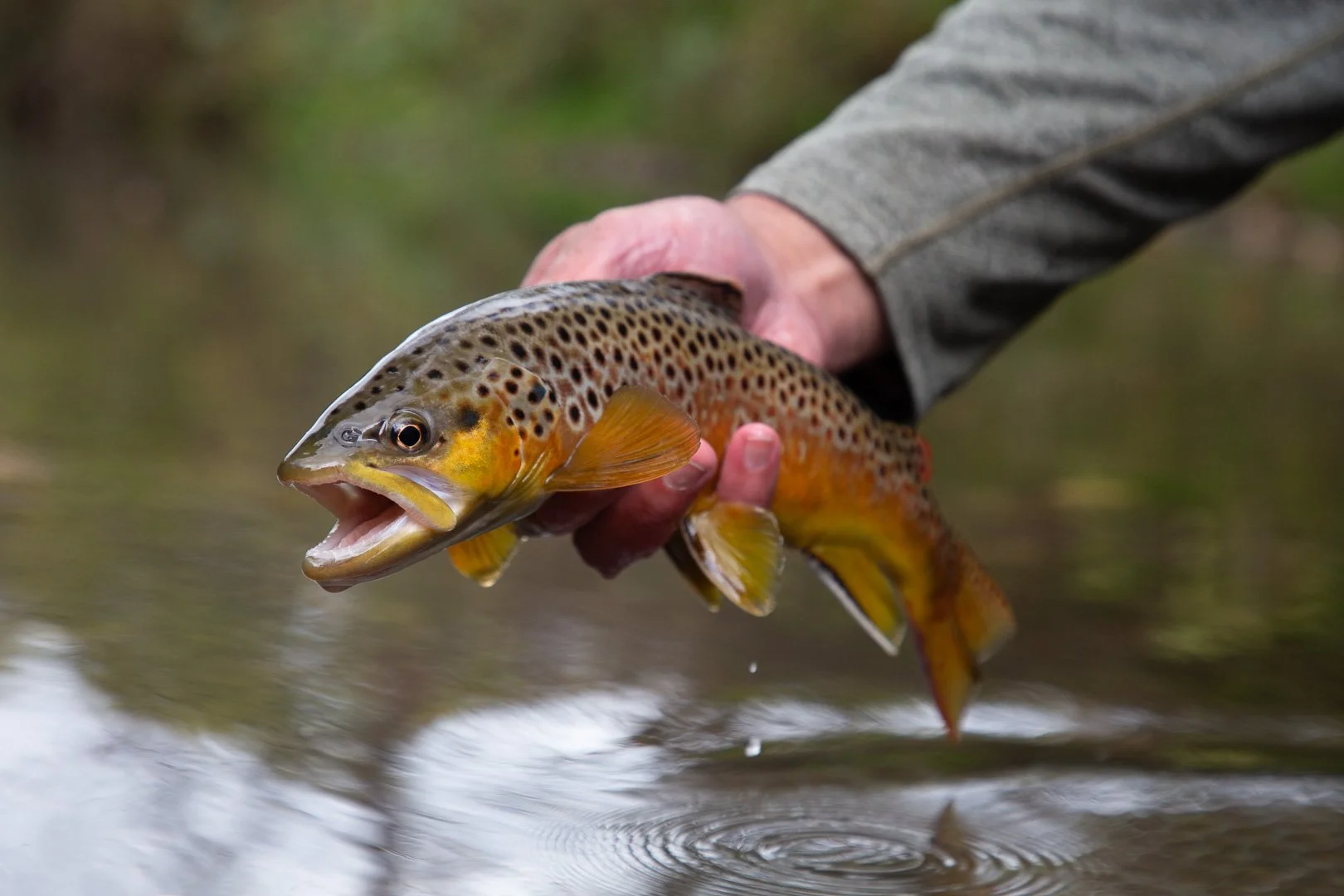
A beautiful fall brown.
Driftless Trout
September is one of the absolute best months to fish trout in the Driftless as cooling temps bring active, aggressive brown and brook trout back to life. Both species have largely been in survival mode through summer, feeding mostly in the shoulder hours of the day or under cover of darkness. That changes as a biological shift kicks in. Both are fall spawners, and you'd be a fool to think it's not on their minds come September. Male fish see a spike in testosterone and start doing what males do when their testosterone surges: fight. They stake out territory and start putting on their fall colors — one more perk to bringing a fish to hand this time of year. The hard-to-find larger fish start moving too, becoming accessible as they shift from deep summer pools into smaller, spawnier water. All of this activity demands calories — more simply put, they have to f#@king eat, and eat a lot. The days of plenty are fading, and they need the energy to survive both the spawn and the winter ahead.
All this great activity on the water comes with a bonus off the water — the crowds thin out like the summer vegetation. As that Driftless jungle dies back, anglers find it easier to get around and a lot friendlier to the back cast, making for a more pleasant experience that delivers the recharge you might be needing. We think it's a good excuse to take a personal health day — the kids are back in school, do something for yourself.
Tactics this time of year are highly condition- and location-dependent. Foam terrestrials are often the go-to, but streamers become increasingly popular as we near October. Nymphs are always in play, and the hatches return to round out the mix. You can't go wrong making the three-hour drive from Chicago or saddling up for the short drive west from Madison. Booking a day of Driftless trout fishing this time of year is setting yourself up for success. If you're looking for the full Driftless immersion, consider our Trout Camp, held in both spring and fall.
September's here. Book a smallmouth day, chase a toothy critter, or get on the Driftless — book at blackearthangling.com.